First-Time Home Buyer Programs in Utah: A Complete 2026 Guide
Buying your first home in Utah can feel both exciting and intimidating.
You may be ready to stop renting, build equity, and create a place of your own, but questions about down payments, mortgage approval, closing costs, and monthly affordability can make homeownership seem out of reach.
The encouraging news is that first-time buyers may have more options than they realize.
A qualified first-time home buyer in Utah may be able to use a low-down-payment mortgage, down payment assistance, a government-backed loan, or a local homeownership program to reduce the upfront financial burden of buying a home.
The right option depends on several factors, including:
Income
Credit history
Employment
Debt
Military service
Property location
Household size
Purchase price
Available program funding
This guide explains common Utah first-time home buyer programs, financing choices, qualification factors, and the steps you can take to prepare for a successful home purchase.
Who Qualifies as a First-Time Home Buyer?
The term “first-time home buyer” does not always mean someone who has never owned real estate.
For many mortgage and assistance programs, a first-time buyer is someone who has not owned and occupied a primary residence during a defined period, commonly the previous three years.
However, the definition can vary by program.
Certain programs may also provide exceptions for:
Displaced homemakers
Single parents
Buyers who previously owned a home with a former spouse
Owners of properties that did not meet applicable building standards
Buyers purchasing in specifically designated areas
Because every program has its own rules, you should not assume that previous homeownership automatically disqualifies you.
A lender familiar with Utah home buyer programs can evaluate your circumstances and explain which options may be available.

Why First-Time Buyer Programs Matter
One of the largest obstacles to homeownership is the upfront cost.
Buyers may need funds for:
A down payment
Closing costs
Earnest money
Inspections
An appraisal
Moving expenses
Initial repairs
Emergency savings
Many prospective buyers believe they must save 20% of the purchase price before they can buy a home.
A 20% down payment can reduce the amount borrowed and may help a conventional borrower avoid private mortgage insurance. However, it is not the only path to homeownership.
Some qualified buyers may be able to purchase with a much smaller down payment. Others may qualify for assistance that helps cover part of the down payment or closing costs.
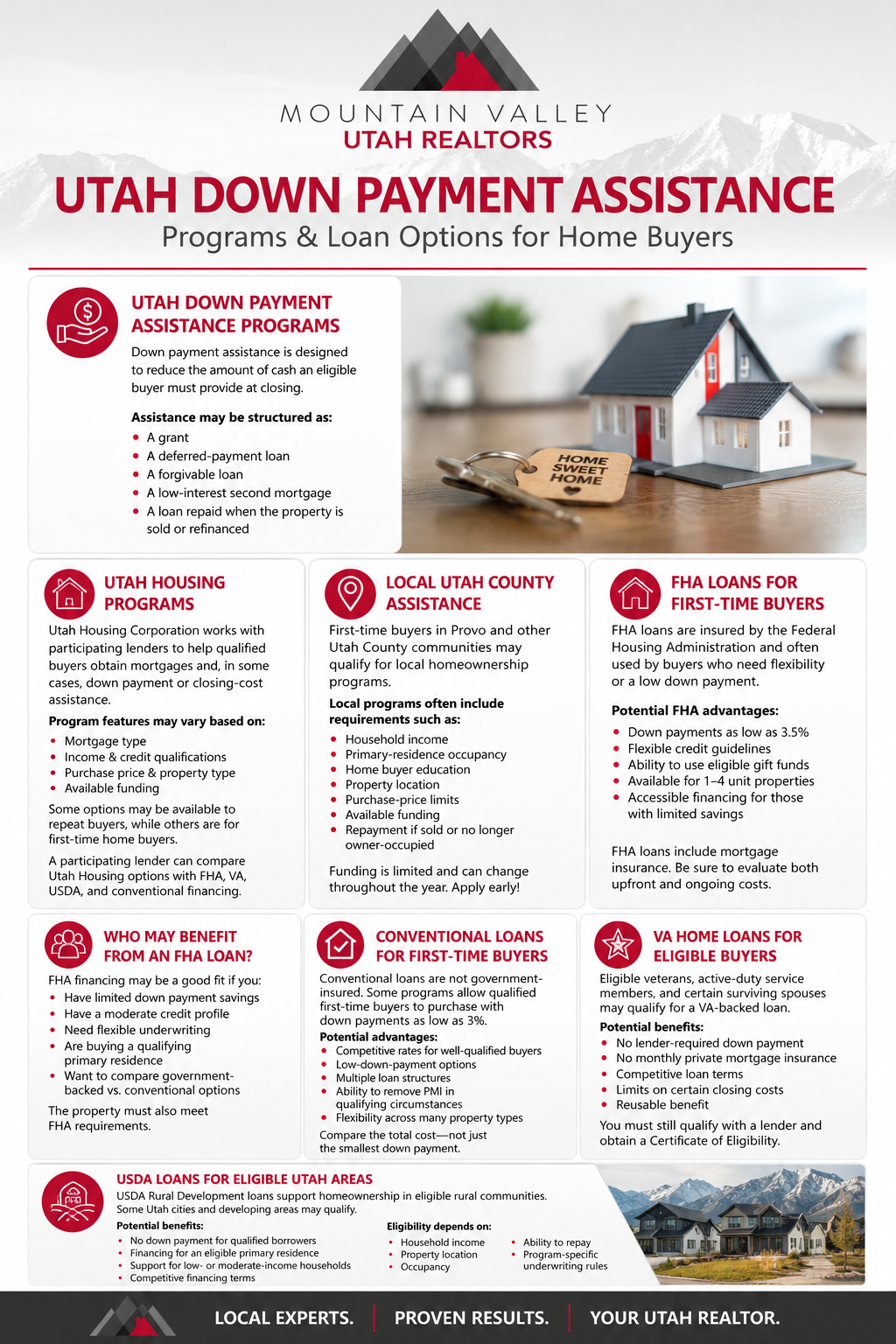
Utah Down Payment Assistance Programs
Down payment assistance is designed to reduce the amount of cash an eligible buyer must provide at closing.
Depending on the program, assistance may be structured as:
A grant
A deferred-payment loan
A forgivable loan
A low-interest second mortgage
A loan repaid when the property is sold or refinanced
Assistance is not automatically free money. Buyers need to understand repayment requirements, interest rates, occupancy rules, and what happens if they refinance or sell.
Utah Housing Programs
Utah Housing Corporation works with participating lenders to help qualified home buyers obtain mortgages and, in some cases, down payment or closing-cost assistance.
Program features may vary depending on:
The underlying mortgage
Borrower income
Credit qualifications
Purchase price
Property type
Available funding
Some Utah Housing options may be available to buyers who are not purchasing their first home, while other assistance programs specifically target first-time buyers.
A participating lender can compare the available Utah Housing options with standard FHA, VA, USDA, and conventional financing.
Local Utah County Assistance
First-time buyers considering Provo or other Utah County communities may also find local homeownership programs.
These programs can be especially valuable because they may provide assistance beyond a standard mortgage.
Local assistance frequently includes conditions involving:
Household income
Primary-residence occupancy
Home buyer education
Property location
Purchase-price limits
Available funding
Repayment when the home is sold or no longer owner-occupied
Funding may be limited and can change throughout the year. Buyers should investigate assistance early rather than waiting until they are ready to submit an offer.
FHA Loans for Utah First-Time Buyers
FHA loans are mortgages made by approved lenders and insured by the Federal Housing Administration.
Although FHA financing is not restricted to first-time home buyers, it is commonly used by buyers who need flexible qualification standards or a relatively low down payment.
Potential FHA advantages include:
Down payments as low as 3.5% for qualifying borrowers
Flexible credit guidelines
The ability to use eligible gift funds
Availability for certain one- to four-unit properties
Potentially accessible financing for buyers with limited savings
FHA loans also include mortgage insurance requirements. Buyers should evaluate both the upfront and ongoing costs rather than choosing a mortgage based only on its minimum down payment.
Who May Benefit From an FHA Loan?
FHA financing may be worth considering when a buyer:
Has limited down payment savings
Has a moderate credit profile
Needs flexible underwriting
Is purchasing a qualifying primary residence
Wants to compare government-backed financing with conventional options
The property must also satisfy applicable FHA requirements.
An experienced lender can help determine whether FHA financing is appropriate for your income, credit, budget, and target property.
Conventional Loans for First-Time Buyers
Conventional mortgages are not insured by the federal government.
Some conventional programs allow qualified first-time buyers to purchase with down payments as low as 3%.
Potential advantages include:
Competitive interest rates for well-qualified borrowers
Low-down-payment options
Multiple fixed- and adjustable-rate structures
The ability to remove private mortgage insurance in qualifying circumstances
Flexibility across many property types
Conventional loans may have stricter credit or debt-to-income requirements than some government-backed options.
However, buyers should compare the total cost of conventional and FHA financing. The loan with the smallest down payment is not always the loan with the lowest long-term cost.
VA Home Loans for Eligible Utah Buyers
Eligible veterans, active-duty service members, and certain surviving spouses may qualify for a VA-backed home loan.
The VA home loan benefit can be one of the strongest home financing options available.
Potential benefits may include:
No lender-required down payment in many qualifying transactions
No monthly private mortgage insurance
Competitive loan terms
Limits on certain closing costs
Reusable benefits for eligible borrowers
VA eligibility does not automatically guarantee mortgage approval. A buyer must still qualify with an approved lender and obtain a Certificate of Eligibility.
The home must generally be purchased for the buyer’s occupancy, and the property must satisfy applicable requirements.
Why VA Buyers Need Experienced Representation
VA purchases involve specific financing procedures, contract language, appraisal requirements, and timelines. Our Mountain Valley Utah Realtors are well versed in VA loans and pride ourselves in our ability to help veterans into their dream home.
A real estate agent familiar with VA transactions can help a buyer:
Identify suitable properties
Explain the offer process
Coordinate with the lender
Communicate with the listing agent
Manage appraisal and inspection timelines
Address common misconceptions about VA financing
A well-prepared VA offer can be competitive when it is supported by strong financing and clear communication.

USDA Loans for Eligible Utah Areas
USDA Rural Development housing programs are intended to support homeownership in eligible rural communities.
Despite the name, a qualifying area does not always feel remote. Some smaller Utah cities and developing communities may fall within eligible boundaries.
Depending on the specific USDA program, potential benefits may include:
No down payment for qualified borrowers
Financing for an eligible primary residence
Support for low- or moderate-income households
Competitive financing terms
Eligibility depends on both the borrower and the property.
Factors can include:
Household income
Property location
Occupancy
Ability to repay
Program-specific underwriting rules
Because eligibility maps and income limits can change, buyers should verify a property rather than assuming that an entire city qualifies.
How Much Money Does a First-Time Buyer Need?
The amount needed to buy a home varies significantly.
Your upfront costs may include:
Down Payment
The required amount depends on the mortgage program. Some qualified buyers may be eligible for no-down-payment financing, while others may choose a down payment of 3%, 3.5%, 5%, or more.
Earnest Money
Earnest money is submitted according to the purchase contract and demonstrates the buyer’s commitment to the transaction.
The treatment of earnest money depends on the contract, deadlines, and contingencies.
Closing Costs
Closing costs may include:
Lender fees
Title charges
Escrow expenses
Prepaid taxes
Homeowners insurance
Recording fees
Appraisal charges
The exact amount depends on the loan, property, purchase price, lender, and negotiated terms.
Inspections
A general home inspection is strongly recommended. Depending on the property, a buyer may also consider specialized inspections for sewer lines, radon, roofing, structural concerns, or other systems.
Reserves
Owning a home means taking responsibility for repairs and maintenance.
Avoid using every available dollar for the purchase. Maintaining an emergency fund can make the transition to homeownership more manageable.
Can a Seller Help With Closing Costs?
In some transactions, a seller may agree to contribute toward allowable buyer closing costs.
The amount and permitted uses depend on:
The mortgage program
The buyer’s down payment
The property type
The appraisal
The negotiated purchase contract
Seller contributions are not guaranteed.
In a competitive market, requesting substantial concessions may weaken an offer. In a market with more inventory or motivated sellers, concessions may be easier to negotiate.
Your buyer’s agent and lender should coordinate before the offer is written so the requested contribution complies with the financing.
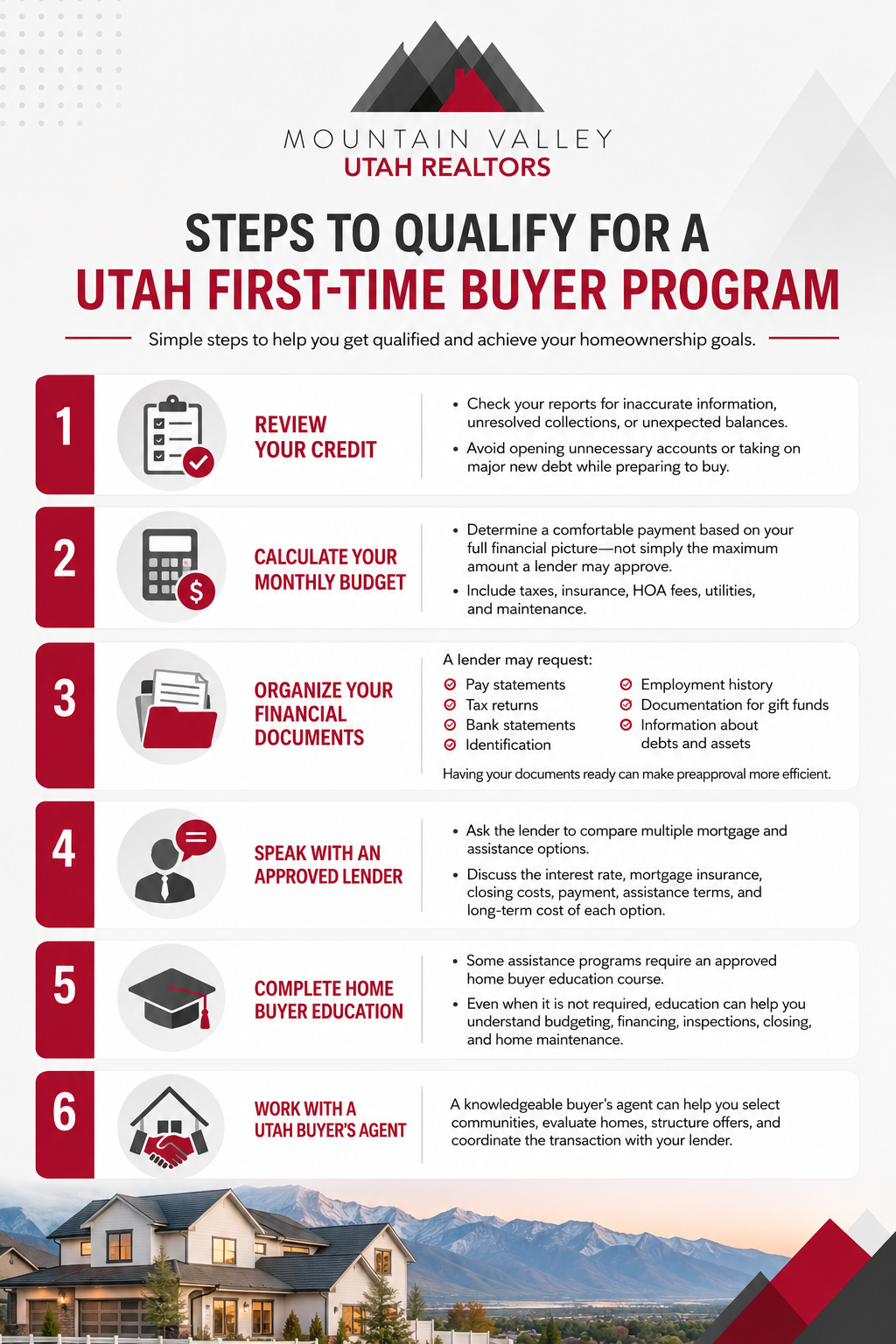
Steps to Qualify for a Utah First-Time Buyer Program
1. Review Your Credit
Check your reports for inaccurate information, unresolved collections, or unexpected balances.
Avoid opening unnecessary accounts or taking on major new debt while preparing to buy.
2. Calculate Your Monthly Budget
Determine a comfortable payment based on your full financial picture—not simply the maximum amount a lender may approve.
Include taxes, insurance, HOA fees, utilities, and maintenance.
3. Organize Your Financial Documents
A lender may request:
Pay statements
Tax returns
Bank statements
Identification
Employment history
Documentation for gift funds
Information about debts and assets
Having your documents ready can make preapproval more efficient.
4. Speak With an Approved Lender
Ask the lender to compare multiple mortgage and assistance options.
Discuss the interest rate, mortgage insurance, closing costs, payment, assistance terms, and long-term cost of each option.
5. Complete Home Buyer Education
Some assistance programs require an approved home buyer education course.
Even when it is not required, education can help you understand budgeting, financing, inspections, closing, and home maintenance.
6. Work With a Utah Buyer’s Agent
A knowledgeable buyer’s agent can help you select communities, evaluate homes, structure offers, and coordinate the transaction with your lender.
Common First-Time Buyer Mistakes
Waiting for a 20% Down Payment
Saving more can be beneficial, but waiting for 20% may not be necessary. Ask a lender to compare low-down-payment options and total monthly costs.
Shopping Before Preapproval
Looking at homes before establishing a realistic budget can lead to disappointment and weaken your position when the right property becomes available.
Comparing Only Interest Rates
A low advertised rate does not tell you the total cost of a loan. Review lender fees, mortgage insurance, assistance repayment terms, and the annual percentage rate.
Ignoring the Total Housing Payment
A mortgage payment is only one part of homeownership. Include taxes, insurance, HOA dues, utilities, repairs, and maintenance in your budget.
Making Financial Changes Before Closing
Changing jobs, financing a vehicle, opening a credit card, moving money between accounts, or making a large purchase can affect approval.
Consult your lender before making significant financial changes.
Skipping Independent Representation
The listing agent represents the seller’s interests unless a different agency relationship is established. A dedicated buyer’s agent can advocate for you throughout the transaction.
Why Work With Mountain Valley Utah Realtors?
Buying your first home involves much more than finding a listing online.
At Mountain Valley Utah Realtors, we help first-time buyers understand the process, prepare for each milestone, and make informed decisions.
Our team can help you:
Explore Utah communities
Define your home-buying priorities
Connect with experienced lenders
Search for homes within your budget
Evaluate comparable sales
Structure a competitive offer
Coordinate inspections and deadlines
Navigate the process through closing
Whether you are looking in Provo, Orem, Lehi, American Fork, Saratoga Springs, Spanish Fork, Park City, Heber City, or another Utah community, we provide personalized guidance based on your goals.

Frequently Asked Questions About Utah First-Time Home Buyer Programs
What programs are available for first-time home buyers in Utah?
Utah buyers may be able to consider Utah Housing mortgage and assistance programs, local down payment assistance, FHA loans, VA loans, USDA financing, and low-down-payment conventional mortgages. Eligibility and availability vary.
How much is the minimum down payment for a first-time buyer in Utah?
There is no single minimum for every buyer. Qualified borrowers may find conventional options beginning around 3%, FHA financing beginning at 3.5%, or eligible VA and USDA programs that do not require a down payment.
Do I have to put 20% down to buy a home in Utah?
No. A 20% down payment may reduce borrowing costs, but many mortgage programs allow qualified buyers to purchase with less.
What credit score do I need to buy my first home?
Credit requirements vary by lender and loan program. Your score can affect eligibility, interest rates, mortgage insurance, and the amount you can borrow.
Can down payment assistance also cover closing costs?
Some programs allow assistance to be used for eligible down payment or closing expenses. The permitted use depends on the program’s current guidelines.
Can I qualify as a first-time buyer if I previously owned a home?
Possibly. Some programs define a first-time buyer as someone who has not owned and occupied a principal residence during the previous three years. Other definitions and exceptions may apply.
Are first-time home buyer programs free money?
Not always. Assistance may be a grant, but it can also be a repayable, deferred, forgivable, or interest-bearing loan. Buyers should review the full terms before accepting assistance.
Can I combine down payment assistance with an FHA loan?
Some assistance programs can be paired with FHA financing, provided the borrower, lender, property, and assistance source meet all applicable requirements.
Are there first-time buyer programs in Utah County?
Yes, qualified buyers may find state and local options. Some local programs serve eligible Provo or Utah County purchases and may have income, location, education, occupancy, and funding requirements.
How do I apply for a Utah first-time home buyer program?
Start by speaking with a lender that participates in the program you are considering. The lender will review your income, credit, assets, debts, property goals, and eligibility.
Is a first-time buyer program always the best choice?
Not necessarily. Assistance can reduce upfront costs but may add a second loan, repayment obligations, or higher financing costs. Compare the full cost and terms with standard mortgage options.
Should I get preapproved before contacting a real estate agent?
You can contact a real estate agent at any stage, but preapproval should usually happen before serious home shopping. It clarifies your budget and helps you act quickly when you find the right home.
Take the First Step Toward Homeownership in Utah
Buying your first home may feel complicated, but a clear plan and an experienced team can make the process easier to navigate.
Start by reviewing your finances, speaking with a knowledgeable lender, and learning which mortgage or assistance programs may fit your situation.
Mountain Valley Utah Realtors is ready to help you move from questions to a confident home search.
Contact Mountain Valley Utah Realtors today to schedule a buyer consultation and begin exploring first-time home buyer opportunities throughout Utah.